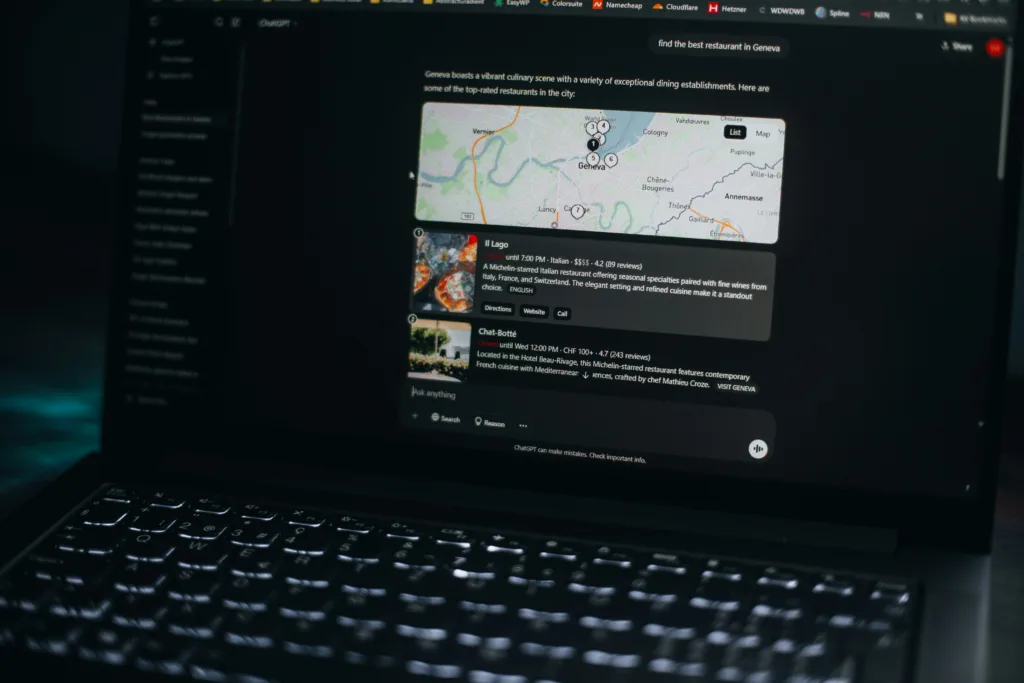
Ranking on Google is no longer the whole game. In 2026, the question isn’t just whether you appear in search results, it’s whether AI tools choose your content when they construct an answer.
That’s what AEO – and the broader discipline of GEO – is about. And unlike some areas of digital marketing, it’s highly actionable. Here’s how to do it.
Step 1: Map the Questions Your Customers Actually Ask
Many teams approach AEO like a formatting pass. They take an existing article, add an FAQ, shorten some paragraphs and call it optimized. That helps, but it doesn’t fix the deeper issue if the page is built around the wrong intent.
The first step is identifying the actual questions your customers ask and not the keywords you want to rank for, but the real questions people type into ChatGPT, speak to voice assistants or ask Perplexity.
Useful sources:
- Google’s “People Also Ask” boxes
- Search Console queries showing how people already find you
- Questions your sales team hears repeatedly
- Long-tail keywords phrased as questions
Build your content around answering these questions directly and completely.
Step 2: Lead With the Answer
Answer engines favor pages that lead with a clear answer, support claims with evidence, demonstrate topical depth and show credible authorship. Pages that bury answers, lack sourcing or haven’t been updated recently are less likely to be selected.
The practical rule: put the answer first, then explain it. Don’t make an AI system read three paragraphs of context before finding the point.
A useful test: if an AI extracted only the first paragraph of your page, would it make sense as a standalone answer? If not, rewrite the opening.
Transform generic headers into questions that match how users query AI. Instead of “Implementation Tips” use “How do you implement AEO effectively?” Instead of “Cost Considerations” use “How much does AEO cost?” This small change significantly increases the chance of your content being matched to a relevant query.
Step 3: Implement Structured Data
Structured data is one of the most direct levers you have for AEO. It tells AI systems not just what your content says, but what type of content it is and how its elements relate to each other.
The schema types with the most impact for AEO are FAQPage, HowTo, Article, Organization and Author/Person schema. Schema works best when it reflects visible content and reinforces authorship, entities and page intent.
For most business websites, starting with FAQPage and Article schema on key pages is the highest-priority first step. If you have a local business, Organization schema is equally important.
Step 4: Build Topical Depth Across Your Site
AI systems evaluate your authority across a topic, not just the relevance of a single page. A website that thoroughly covers a subject from multiple angles is more likely to be cited than one with a single well-optimized article.
This means building content clusters – a main page that covers a topic comprehensively, supported by related articles that address specific subtopics and questions. Internal linking between these pages signals to AI systems that your site has genuine depth and authority on the subject.
AEO is not about tricking answer engines. It is about conditioning the market so buyers, Google, ChatGPT, Perplexity and other answer systems understand why your brand belongs in the answer.
Step 5: Demonstrate E-E-A-T
AI systems are increasingly selective about which sources they trust. E-E-A-T – Experience, Expertise, Authority and Trustworthiness – is how Google and AI tools evaluate whether your content deserves to be cited.
In practice this means:
- Named authors with visible credentials and bios
- Links to credible external sources that support your claims
- Regular updates to keep content accurate and current
- Third-party mentions of your brand on reputable sites outside your own domain
“For commercial and evaluation-stage queries, 83 percent of AI citations came from pages updated within the past 12 months, with more than 60 percent refreshed within the last six months. Freshness isn’t optional, it’s a citation signal.”
Step 6: Optimize for Featured Snippets
Featured snippets are the original “position zero” answer boxes that Google has displayed since 2014. They remain a high-visibility surface for direct answers and often feed into AI Overviews. Optimizing for featured snippets – using concise 40–60 word answers, list formatting and table formatting which directly supports AEO goals.
If you’re not already targeting featured snippets, start here. It’s one of the fastest ways to improve both traditional SEO visibility and AEO citation probability at the same time.
Step 7: Keep Your Technical Foundation Strong
AEO doesn’t replace technical SEO, it builds on top of it. Many technical best practices of SEO continue to support AEO, with additional emphasis on structure and metadata. Make sure your site is accessible to crawlers and loads quickly.
A slow, poorly structured site that Google can’t crawl efficiently won’t be cited by AI tools either. Core Web Vitals, mobile optimization, clean URL structure and HTTPS remain non-negotiable prerequisites.
Step 8: Earn External Mentions
One of the clearest differences between AEO and traditional SEO is how much weight external mentions carry. AI systems don’t just look at your website, they look at how your brand and expertise are referenced across the wider web.
Being mentioned in industry publications, featured in “best of” lists, quoted in relevant articles or referenced by credible third-party sources all strengthen your authority in the eyes of AI tools. This is why PR, thought leadership and content partnerships matter more than ever as part of a complete AEO strategy.
Summary
AEO optimization comes down to nine steps: map the right questions, lead with the answer, implement structured data, build topical depth, demonstrate expertise, target featured snippets, maintain technical health, earn external mentions and measure what matters.
Strong SEO gets you into the game. AEO determines whether you become the answer.
Want to know how your website performs for AI visibility today? Get in touch and we’ll show you where you stand and what to prioritize first.